

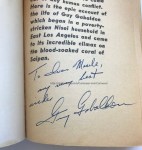
Vintage MTI (Movie Tie-In) SIGNED by Guy Gabaldon (the Marine war hero and subject of the 1960 film), starring Jeffrey Hunter, David Janssen, Vic Damone, George Takei, Patricia Owens, Richard Eyer [as young Guy Gabaldon (“The 7th Voyage of Sinbad,” “The Invisible Boy,” “The Desperate Hours”), John Larch (“Dirty Harry,” “The Amityville Horror,” “Play Misty For Me”), Bill Williams (“The Adventures of Kit Karson”), Reiko Sato (“Flower Drum Song,” “The Ugly American”) & Miiko Taka (“Sayonara”).
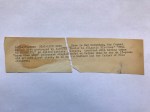
The book also includes a typed press release that was attached by paper clip inside the book, likely by the original owner Ivan Maule, to whom it was signed by Gabaldon.
From Wikipedia:
Guy Louis Gabaldon (March 22, 1926 – August 31, 2006) was a United States Marine who, at age 18, captured or persuaded to surrender over two thousand Japanese soldiers and civilians during the battles for Saipan and Tinian islands in 1944 during World War II. Though Gabaldon was recommended for the Medal of Honor, he received the Silver Star, which was upgraded by the Marine Corps to the Navy Cross in 1960.In 1960, a friend of Gabaldon’s with Hollywood connections influenced the industry to make a movie about Gabaldon’s version of events on Saipan called Hell to Eternity. He was called ‘Gabby’ by his friends, and was an outspoken member of right-wing political organizations. In 1964, he unsuccessfully ran for US Congressman in his Southern California district. In 1990, he authored a book entitled, Saipan: Suicide Island.
Gabaldon was born in Los Angeles, California. Gabaldon, who was of Mexican descent, was one of seven children. He was raised in East Los Angeles and, as a ten-year-old, he helped his family by shining shoes on Skid Row. Gabaldon became a member of a multi-ethnic gang known as the “Moe Gang”. At age 12, he moved out of his home to live with the Nakano family, which was of Japanese-American heritage and whom he considered his extended family. He attended language school every day with their children and learned to speak Japanese. He also learned about their customs and culture.
The United States considered the possibility of a full scale invasion of the Japanese mainland but later decided that such a feat would be costly, with an estimated one million American casualties. The capture of Saipan was considered essential for the establishment of airfields which would accommodate the B-29 Superfortress bombers to be used for the planned invasion. On June 15, 1944, an armada of 535 ships, carrying 127,570 U.S. military personnel which included Marines from the 2nd and 4th Marine Divisions, began the invasion of Saipan. Japanese soldiers seldom surrendered during World War II and, as the American military invasion went badly for the Japanese, they were ordered by their superiors on Saipan to kill seven American Marines or soldiers for every soldier they lost, or commit suicide.
According to Gabaldon, he began taking and bringing in prisoners the night of the first day that he arrived on Saipan.
“The first night I was on Saipan, I went out on my own…I always worked on my own, and brought back two prisoners using my backstreet Japanese.”
Gabaldon was reprimanded by his superior officers, and threatened with a court-martial for leaving his post. However, according to him the next night he went out and did it again. He carefully approached a cave, shot the enemy guards outside, moved off to one side of the cave, and yelled in Japanese, “You’re surrounded and have no choice but to surrender. Come out, and you will not be killed! I assure you will be well-treated. We do not want to kill you!”
The next morning he says he returned with 50 Japanese prisoners. As a result, Gabaldon was permitted by his commanding officer to act as a “lone wolf” operator.
The next day, on July 8, Gabaldon captured two more enemy guards. He convinced one of them to return to his cave, with an offering of surrender. Shortly thereafter, a Japanese officer showed up. After speaking to Gabaldon, the officer accepted the conditions of surrender—and over eight hundred Japanese soldiers and civilians surrendered to Gabaldon, who turned them over to the U.S. military authorities. For his exploits, according to Gabaldon, he became known as The Pied Piper of Saipan.
Gabaldon continued to capture more Japanese people on Tinian. While back on Saipan fighting Japanese guerrillas still on the island, he was seriously wounded in an enemy machine gun ambush. Gabaldon claimed he was credited with the capture of approximately 1,500 Japanese soldiers and civilians on Saipan and Tinian and was recommended for the Medal of Honor by his commanding officer Captain John Schwabe, who noted that Gabaldon single-handedly captured more than ten times the number of prisoners taken by legendary Medal of Honor recipient, Sgt. Alvin C. York, in World War I. Despite this recommendation, Gabaldon was awarded a Silver Star Medal.
From IMDB:
* The real Guy Gabaldon–unlike Jeffrey Hunter, the tall Anglo actor who played him–was Chicano and only 5’4", 130 pounds. He enlisted in the Marines after Pearl Harbor at age 17. Even though he captured more enemy soldiers single-handedly than anyone else, including WW I hero Sgt. Alvin C. York, he was not awarded the Medal of Honor, as York was.* Several hundred veterans of the Japanese Imperial Army took part in the re-creation of the Battle of Saipan, which was filmed on Okinawa. In addition, about 500 U.S. Marines from Camp Hansen on the island were used in this film.
* There were initially many objections to the striptease dances done by Famika and Sheila, and both were cut considerably in reaction to those objections.
* The screen rights for Guy Gabaldon’s story were initially purchased by Gramercy Pictures the day after he appeared on the This Is Your Life (1952) broadcast of June 19, 1957.
* In the film, Guy Gabaldon’s adoptive Japanese-American family the Unes is taken from their home in Los Angeles and sent to an internment camp farther inland for the duration of the war. In reality, actor George Takei–who played George Une–was five yeas old at the beginning of World War II and he and his family were taken out of their home and sent to an internment camp in Arkansas for the duration of the war.
* Opening credits: This is the story of an immortal fighting man of World War II. Many who never even knew Guy Gabaldon are alive at the present time because of him. Though this United States Marine’s deeds came into history’s sharp focus on the bloodied hills of Saipan, his story starts in the melting pot of East Los Angeles during the great depression of the early Thirties.
Title: Hell to Eternity
Author: Edward S. Aarons
Publisher: Gold Medal 1023
Cover Illustration: Barye Phillips
Paperback Original (PBO)
Printing: 1st, August 1960

 BadLuckGreaser